5G for Remote Care: Developing Sensor-Free Activity Monitoring
Non-invasive RF sensing for dignified elderly care without wearables
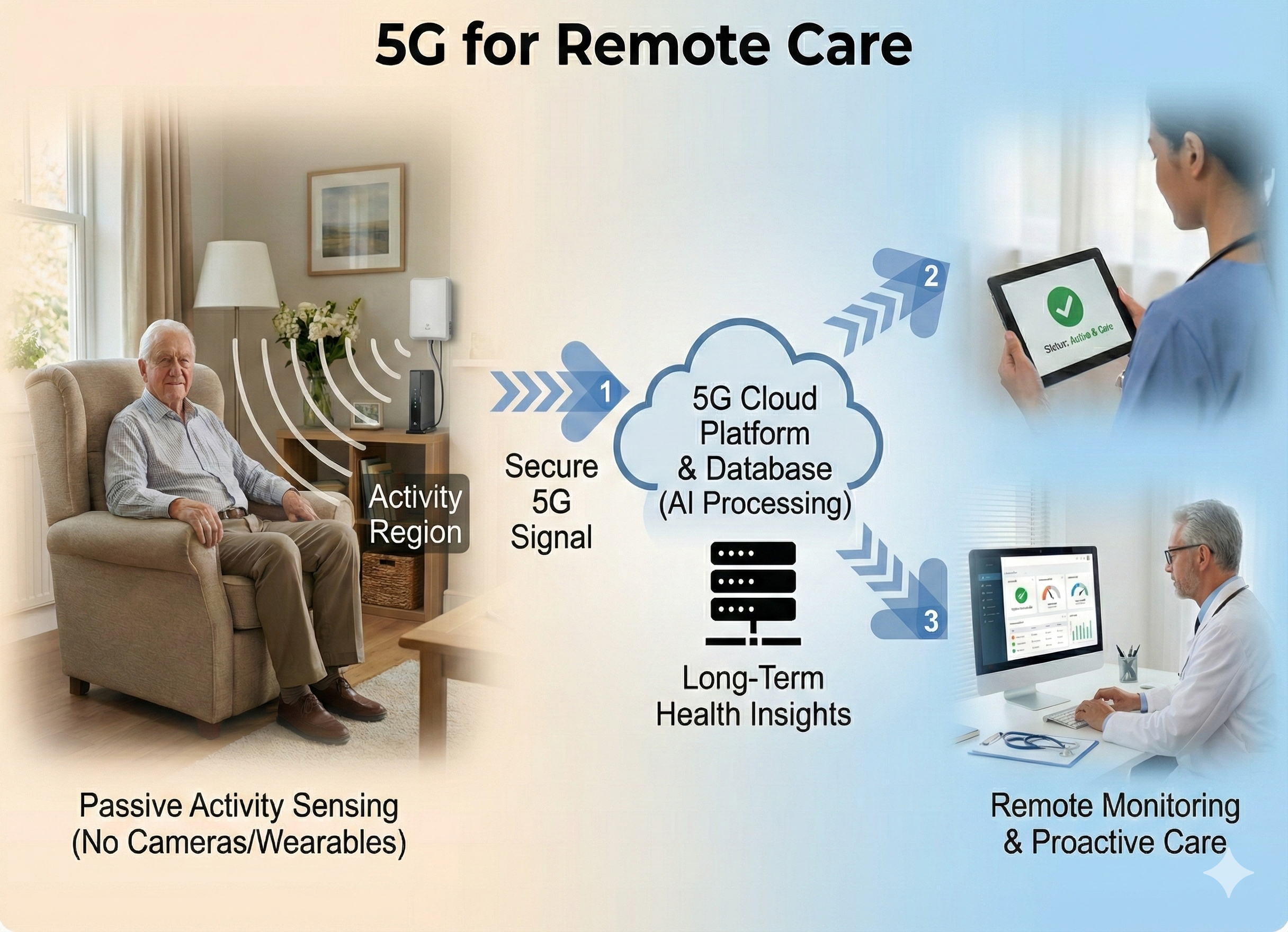
The Story
The Challenge
Traditional remote health monitoring systems — including our earlier NHS-deployed TIHM solution — require multiple intrusive sensors or wearable devices. This creates significant barriers: high deployment costs, privacy concerns, and low user acceptance among elderly populations who find wearables uncomfortable or stigmatizing. For remote and rural communities, these challenges are amplified by limited infrastructure and specialist support.
My Contribution
As a co-investigator and Work Package Lead from the University of Glasgow on the 5G New Thinking Project (funded by Scottish Government and DCMS), the UoG team led by Prof Muhammad Imran successfully developed a Portable Non-Invasive Radio Frequency (RF) Sensing System for assistive living — a fundamentally different approach that monitors activities without any on-body sensors.
How It Works
The system uses Software Defined Radio (SDR) devices to extract Channel State Information (CSI) from continuous streams across multiple subcarriers. By analyzing how RF signals propagate between transmitting and receiving nodes, we detect variances in signal amplitude caused by human movement — enabling advanced gait and motion analysis to infer daily activity patterns.
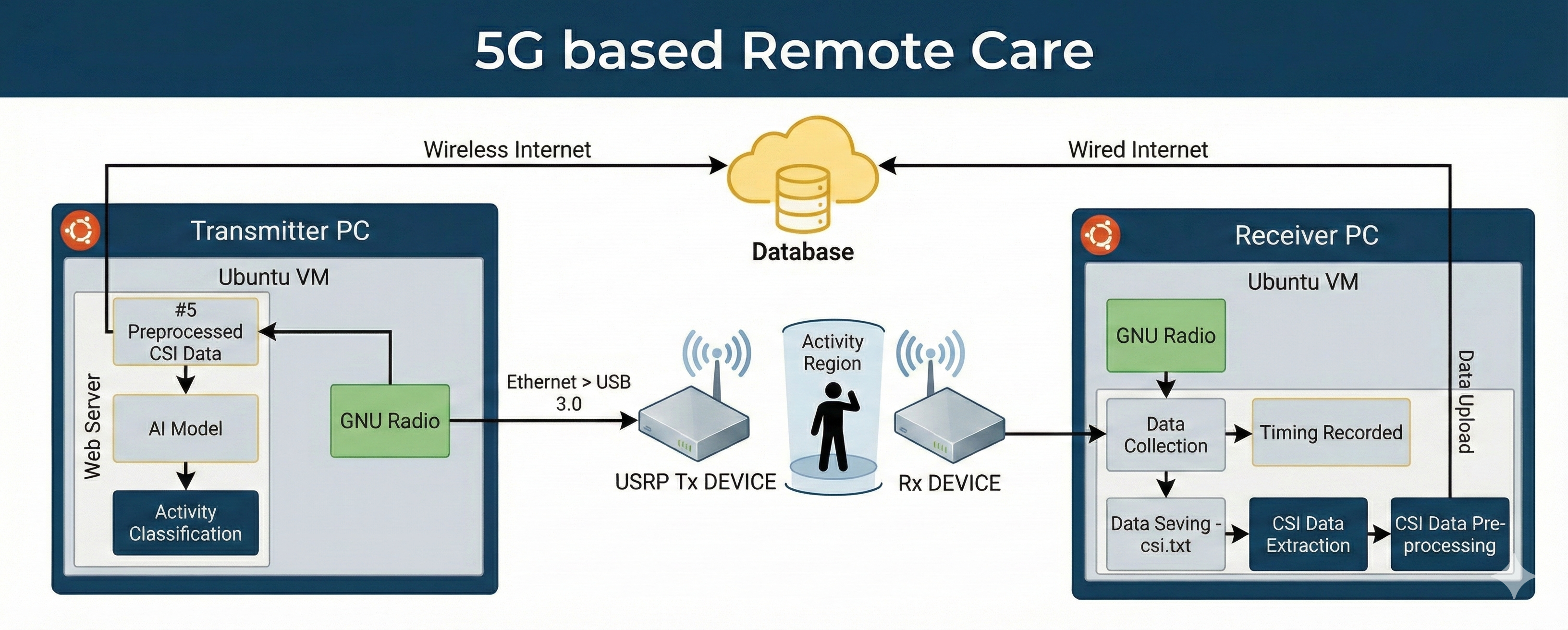
The key innovation lies in using Orthogonal Frequency-Division Multiplexing (OFDM) to capture small-scale signal propagation, providing sensitivity to detect subtle movements that indicate health changes.
The Role of 5G
Our system was specifically designed to operate in the 5G band at 3.75 GHz — making it a true 5G-native sensing solution. We secured Ofcom licensing approval to operate at this frequency, enabling deployment beyond the lab.
The choice of 5G was strategic for three reasons:
- 5G frequency for sensing — Mining CSI from 5G communication channels with 20 MHz bandwidth provides the resolution needed for accurate activity detection
- Split-second response times — 5G's low latency enables health applications requiring immediate decisions, particularly for detecting emergencies like falls
- Network virtualization — 5G's ability to dynamically set up and tear down services without human intervention is critical for portable, pop-up health sensing deployments
The Trial
We conducted a two-phase validation:
Phase 1: University Lab Trials
Systematic experiments applying 5G sensing for non-invasive activity monitoring, with results published in Nature Scientific Reports.
Phase 2: Real-World Deployment
Partnered with Albyn Housing Society in Alness, Scotland (a community with active 5G licenses) and CISCO to test the system in an actual remote care home setting.
We performed comprehensive latency analysis to determine feasibility of integrating actuating systems for future applications — proving that 5G can reliably support health emergencies requiring immediate response.
The Impact
- Published the 5G-enabled activity detection research dataset (DOI: 10.5525/gla.researchdata.1151), openly available to accelerate global research
- Research published in Nature Scientific Reports
- Technology incorporated into 2 international patent citations (DE-102022128862-A1, DE-102023123138-A1)
- Addresses fall detection — the second leading cause of accidental deaths globally (WHO)
- Provides evidence-led foundation for how 5G-enabled "human-fidelity remote healthcare" can transform care delivery in remote and rural locations
Why It Matters
This work demonstrates that the future of remote health monitoring doesn't require people to wear devices or fill their homes with sensors. By harnessing 5G's unique capabilities — both as a sensing medium and connectivity backbone — we've created a blueprint for dignified, non-invasive care that can scale to underserved communities worldwide. The openly released dataset ensures this isn't just our innovation, but a foundation for global research acceleration.
International Patent Citations
Key Partners
- Scottish Government
- DCMS
- Albyn Housing Society
- CISCO
- Ofcom
Related Project
5G New Thinking View full project details →Interested in 5G Healthcare?
Let's discuss potential collaborations in 5G-enabled health solutions.
Get in Touch