From Campus Testbed to Real-World Validation: AI-Driven Energy Monitoring for Assisted Living and Net Zero
A dual-purpose platform serving health monitoring and sustainability goals
The Story
The Challenge
With the rising cost of energy consumption and with carbon emissions fast becoming one of the world's most pressing challenges, it's important to re-evaluate energy usage and come up with a strategy to change collective behaviours to save money and resources.
At the same time, an aging population requires ambient assisted living solutions that can monitor wellbeing non-invasively. We asked: could a single intelligent system address both challenges simultaneously?
Phase 1: Building the University Testbed
I led the development of the Persuasive Energy Conscious Network (PECN) — a 5G-enabled energy sensing and optimisation system of 60+ energy monitoring nodes live in a 2,000-occupant campus building (James Watt South Building, University of Glasgow), shown at COP26.
PECN allows businesses to assess energy usage, monitoring occupancy in real-time and providing accurate data to reduce costs. Carbon emissions would be reduced by using this technology, helping businesses and organisations to achieve Scotland's Net Zero targets.
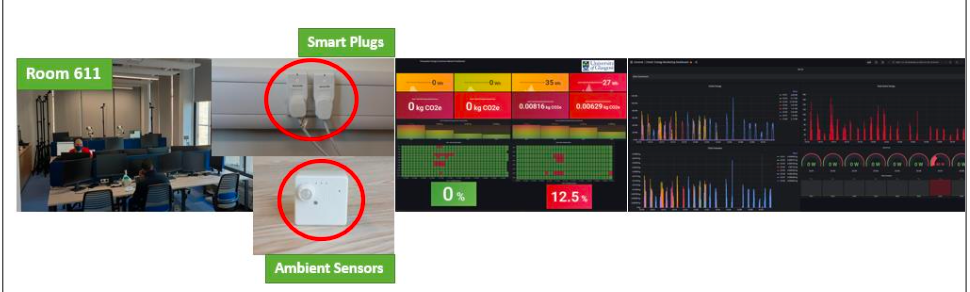
The system captures granular, real-time electricity consumption data, enabling machine learning analysis of appliance usage patterns, occupancy behaviours, and energy efficiency opportunities.
Phase 2: Industrial Partnership with Briteyellow
Through the EPSRC Impact Acceleration funded COIL project (Energy Conscious Network for Independent Living), we partnered with Briteyellow Ltd, a telehealth company with expertise in wearable user tracking. The collaboration merged two complementary technologies:
Granular energy consumption monitoring
Indoor user location and activity tracking
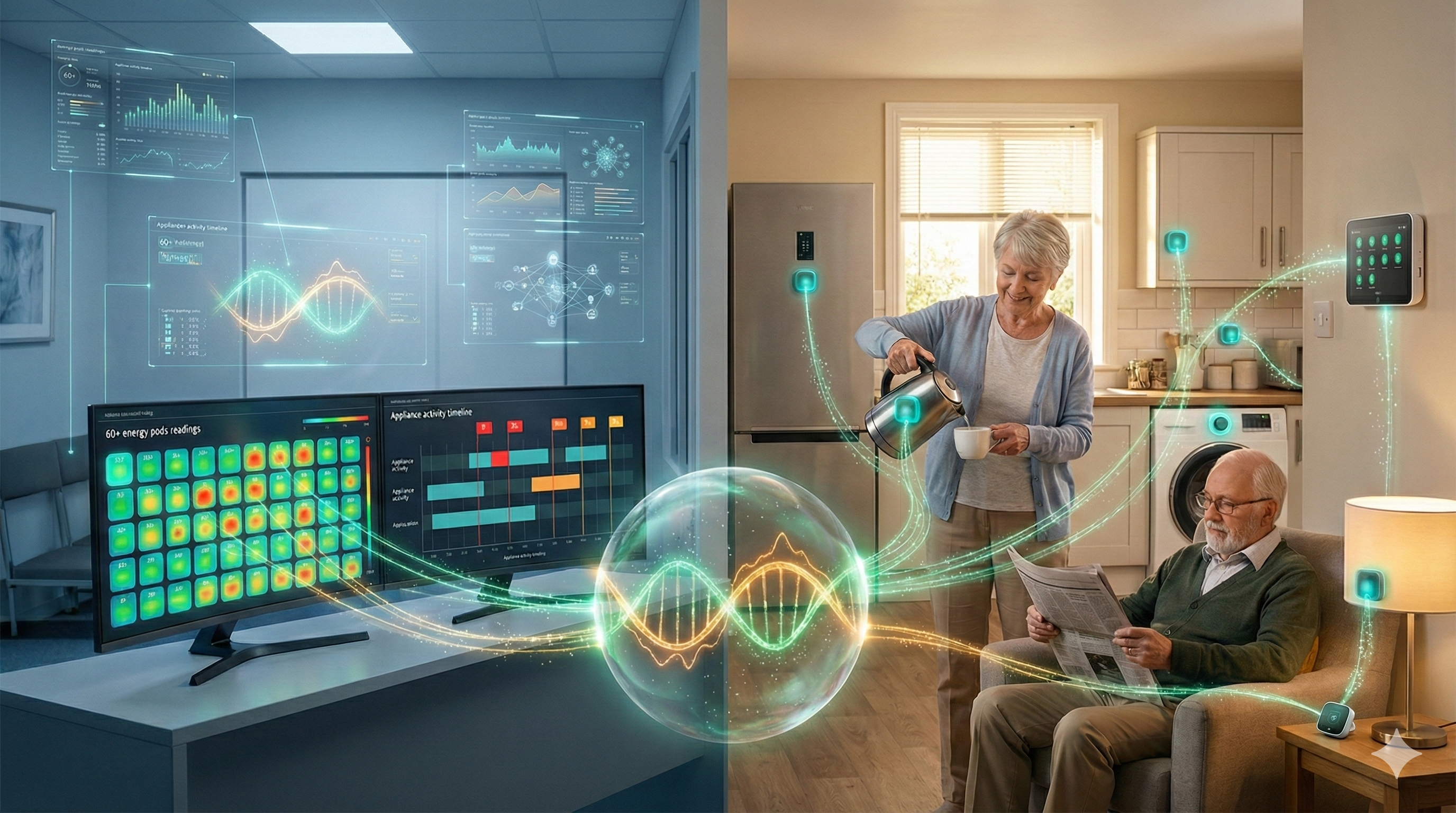
This integration created an Ambient Assisted Living (AAL) framework capable of correlating user movements with appliance usage — enabling detection of behavioral anomalies that may indicate health issues such as memory lapses or early signs of cognitive decline.
Phase 3: Real-World Deployment and Validation
We deployed the integrated system at Briteyellow's offices for a four-month trial, monitoring an environment with approximately 20 daily occupants. The real-world data revealed:
- Clear correlations between user density, daily routines, and energy consumption patterns
- Ability to detect anomalous appliance interactions (e.g., devices left on unexpectedly)
- Potential early warning indicators for health issues through deviations in routine behaviors
Our machine learning algorithms for energy forecasting and anomaly detection demonstrated that monitoring energy patterns alone can provide meaningful insights into occupant wellbeing — without invasive sensors or wearables.
The Impact
- Research Testbed: 60+ node deployment enabling ongoing research in energy modeling and activity detection
- Real-World Validation: 4-month deployment at Briteyellow proving commercial and technical viability
- Publication: Federated learning approach for anomaly-aware load forecasting published in Sensors journal (DOI: 10.3390/s23073570)
- Industry Showcase: Demonstrated to Nokia, Vodafone, Huawei, and delegations from UESTC China and Pakistani universities; featured by Scotland 5G Centre as a 5G-enabled energy and environmental monitoring solution
- COP26 Showcase: Presented to policymakers and public, demonstrating how AI supports Scotland's Net Zero targets
- Public Engagement: Presented to young female students at Glasgow City Council Civic Reception, inspiring future STEM careers
- Policy Relevance: Opportunities to reduce carbon footprints through sensing, monitoring and data insight allow businesses and individuals to make choices to change their behaviour and decision-making based on energy emissions they generate
- Follow-on Funding: Contributed to securing follow on EPSRC Impact Acceleration and Scotland 5G Centre Phase II projects funding
Why It Matters
The race against climate change and the huge increase in energy prices presents huge challenges for organisations. A simple and effective 5G solution like the Persuasive Energy Conscious Network can help businesses in assessing their energy usage behaviours and work towards improving it.
By starting with rigorous university-based research, then validating through industrial partnership, we've created a pathway from lab to real-world deployment — demonstrating that health tech and climate tech can work together.
COP26 Showcase
Industry Showcase
Publication
Federated Learning for Anomaly-Aware Load Forecasting Sensors Journal DOI: 10.3390/s23073570 →Key Partners
- EPSRC
- Briteyellow Ltd
- University of Glasgow
- Scotland 5G Centre
- Glasgow City Council
Related Projects
Policy Relevance
Interested in Energy AI?
Let's discuss potential collaborations in energy and assisted living.
Get in Touch