5G New Thinking (UoG)
Developing 5G testbed networks in remote island locations and delivering use case trials in agriculture and healthcare, exploring how communities can "self-provision" their own next-generation communications networks.
Project Overview
5G New Thinking was an ambitious DCMS-funded project involving 18 consortium partners working with rural communities across the UK to address the rural connectivity challenge. The project developed 5G testbed networks in remote island locations in Orkney and delivered use case trials in agriculture and healthcare, exploring how communities can "self-provision" their own next-generation communications networks.
A key output was the Rural Connectivity Toolkit — an online resource enabling remote communities to learn about building and operating their own mobile and wireless networks, covering business planning, network construction, and operational guidance.
University of Glasgow's Contribution: Healthcare Use Case
As Work Package Lead from the University of Glasgow team led by Prof Muhammad Imran, I directed the development of a Portable Non-Invasive Radio Frequency Sensing System for Assistive Living — one of the project's flagship use cases demonstrating how 5G can transform remote healthcare delivery.
Use Case Description
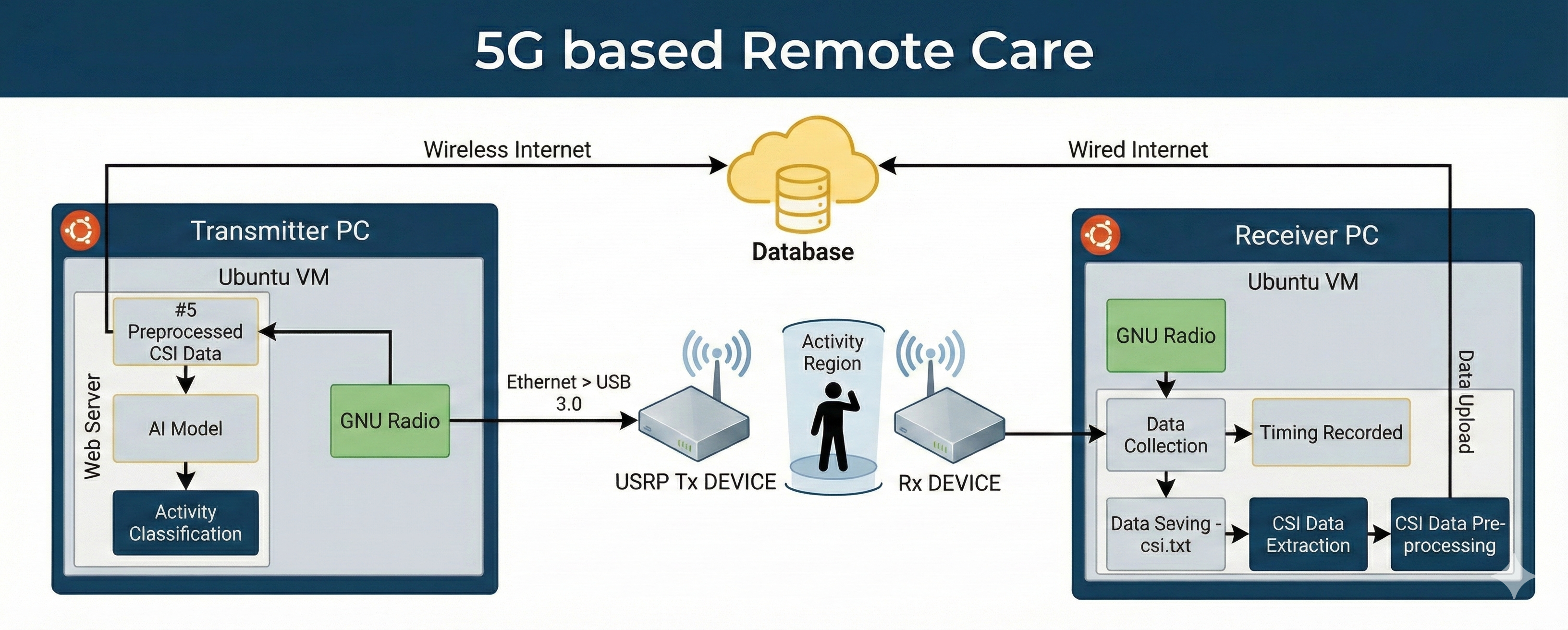
The system uses Software Defined Radio (SDR) devices to extract Channel State Information from RF signals, enabling detection of daily activity patterns through advanced gait and motion analysis — without requiring wearable sensors or invasive monitoring equipment. This addressed key limitations of existing remote monitoring approaches: camera-based systems raise privacy concerns, ambient sensors are expensive, and wearables require proper mounting and user compliance.
The Role of 5G
- 5G Frequency for Sensing: The system operated in the 5G band at 3.75 GHz, demonstrating that activity patterns captured at 5G frequencies show higher recognition accuracy compared to Wi-Fi bands
- Low-Latency Connectivity: 5G's speed enables split-second health emergency decisions; latency analysis confirmed feasibility of integrating actuating systems for future applications
- Network Virtualisation: 5G's ability to dynamically configure services without human intervention is critical for portable, pop-up health sensing deployments
Trial Implementation
- Secured Ofcom licensing approval to operate at 3.75 GHz
- Conducted lab trials at University of Glasgow with results published in Nature Scientific Reports
- Partnered with Albyn Housing Society to deploy the system in a remote care home setting in Alness, Scotland
- Released one of the first 5G-enabled activity detection research datasets (DOI: 10.5525/gla.researchdata.1151) for the global research community
Technical Architecture
Key Outcomes & Impact
| Output | Detail |
|---|---|
| Dataset Released | First openly available 5G-enabled activity detection dataset |
| Publication | Results published in Nature Scientific Reports |
| Real-World Trial | 4-month deployment at Albyn Housing Society care home |
| Technology Validated | RF sensing accuracy benchmarked against existing sensor-based systems |
| Toolkit Contribution | Healthcare use case integrated into Rural Connectivity Toolkit |
| Patents | Technology cited in 2 international patents |
| Policy Relevance | Demonstrated how 5G can support NHS remote care and Scotland's health priorities |
Why This Matters
The 5G New Thinking project demonstrated that rural connectivity challenges are surmountable when communities, academia, and industry work together. The University of Glasgow's healthcare use case proved that 5G-native sensing can enable dignified, non-invasive remote care for vulnerable populations — particularly in remote and rural locations where traditional healthcare infrastructure is limited. The openly released dataset ensures this research accelerates global innovation in human-fidelity remote healthcare.
Key Publications
5G-Enabled Contactless Multi-User Presence and Activity Detection for Independent Assisted Living
DOI: 10.1038/s41598-021-96689-7Project Details
- Role Work Package Lead
- Total Value £4.3M consortium
- Funder DCMS UK
- Period 2019-2022
- Partners 18 organizations
Project Team (UofG)
- Dr Ahmed ZohaCo-Investigator/Work Package Lead
- Dr Ahmad TahaPostdoctoral Research Associate
- Dr Qammer AbbasiCo-Investigator
- Prof Muhammad Ali ImranPrincipal Investigator
International Patent Citations
Open Dataset
5G-Enabled Activity Detection Dataset First openly available 5G-enabled activity detection dataset Open access →Key Partners
- CISCO
- University of Strathclyde
- Albyn Housing Society
- Rural communities across Scotland
- Orkney communities
- University of Glasgow