Energy Conscious Network for Independent Living (COIL)
Advanced Ambient Assisted Living solution combining energy consumption analytics with location and physiological tracking to detect behavioural anomalies indicative of cognitive decline — without requiring wearable devices.
Project Overview
With 2 million people in the UK using telecare services — projected to reach 3 million by 2030 — and the Ambient Assisted Living (AAL) market expected to reach USD 13.74 billion by 2027, there is urgent demand for intelligent, non-intrusive health monitoring solutions.
Over 80% of dementia patients prefer to remain in their own homes, yet evidence shows that moving people into residential care can actually hasten disease progression. COIL addressed this challenge by developing an advanced AAL solution that combines energy consumption analytics with location and physiological tracking to detect behavioural anomalies indicative of cognitive decline — without requiring wearable devices.
Technical Innovation
COIL merged two proven platforms developed through my previous research:
1. PECN (Persuasive Energy Conscious Network)
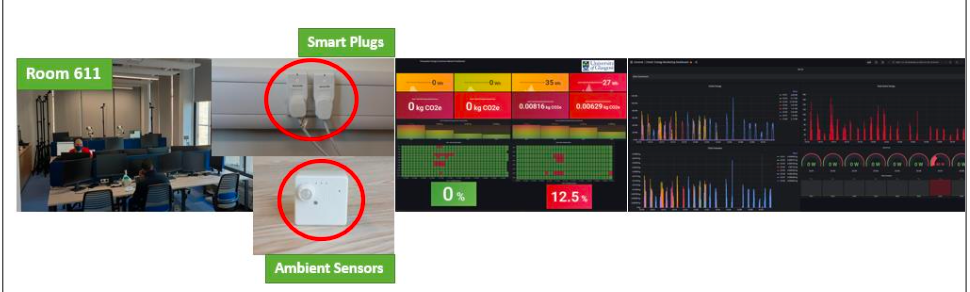
A network of 60+ LoRa-enabled smart energy monitoring nodes deployed across University of Glasgow's James Watt South Building, featuring a real-time AI-powered analytics dashboard for energy and space utilisation modelling.
2. BriteCare Platform (Briteyellow Ltd)
A wearable and mobile app for elderly and disabled users that tracks movement, analyses behaviour using AI, and sends alerts to caregivers. Among the first to use 5G technology for centimetre-level indoor positioning.
The COIL Innovation
By augmenting PECN's energy analytics with BriteCare's tracking, the system can detect Activities of Daily Living (ADL) — food preparation, appliance use, sleep patterns — without requiring patients to wear monitoring devices. For example, repeatedly forgetting to turn off an oven, or increased energy consumption during late evenings, could indicate memory problems or the "sundowning syndrome" associated with dementia.
Real-World Deployment & Results
The system was deployed for 4 months at Briteyellow's offices in Cranfield Technology Park, demonstrating:
- Clear correlation between user density, daily routines, and appliance usage patterns
- Anomaly detection capability for identifying unusual energy interactions indicative of potential health issues
- Machine learning algorithms for energy forecasting and alerting when appliances are inadvertently left on
- Integration pipeline successfully merging PECN energy data with BriteCare location tracking
Key Outcomes & Impact
| Output | Detail |
|---|---|
| MVP Deployed | Minimal Viable Product tested in real-world setting (Nov 2022) |
| Publication | Sensors journal paper on federated learning for anomaly-aware load forecasting |
| Industry Showcase | Demonstrated to Nokia, Vodafone, Huawei, Scotland 5G Centre |
| Scotland 5G Centre Feature | Listed as 5G-enabled energy and environmental monitoring solution |
| Demonstration Video | Featured on University of Glasgow YouTube channel |
| Partner Engagement | Briteyellow Ltd, NHS Scotland Primary Care Network, Albyn Housing Society |
| Academic Visits | Demonstrated to UESTC China President, delegation of Vice Chancellors from Pakistan |
Building on Prior Research
COIL extended the impact of multiple preceding projects:
- TIHM (NHS England Test Beds): AI algorithms developed for 200+ homes now integrated into COIL dashboard
- REDUCE (EPSRC EP/I000232/1): User-centric energy behaviour insights applied to care settings
- PECN Testbed: 60+ monitoring nodes providing foundation infrastructure
Strategic Alignment
The project directly supports:
- EPSRC Priority Theme: Transforming Health and Healthcare
- UK Net Zero 2050 Strategy: User-centric energy models addressing fuel poverty
- NHS Long-Term Plan: Digital transformation of health and social care
- Scotland 5G Strategy: Demonstrating 5G-enabled healthcare and energy solutions
Why This Matters
COIL demonstrates that energy consumption patterns are a window into health and wellbeing — enabling non-intrusive monitoring that respects dignity while detecting early signs of cognitive decline. By identifying when someone forgets to turn off an appliance or shows unusual nighttime activity patterns, caregivers can intervene proactively rather than reactively. This approach supports independent living, reduces hospital admissions, and addresses the dual challenges of an ageing population and climate change through intelligent energy management.
Key Publications
References
- • Scotland 5G Centre: scotland5gcentre.org/s5gcprojectglasgow/
- • Publication: doi: 10.3390/s23073570
Project Details
- Role Principal Investigator
- Value £30,000
- Funding EPSRC IAA
- Period September 2022 – March 2023
- IAA Programme 2022-2025
Project Team
- Dr Ahmed ZohaPrincipal Investigator
- Dr Masood NizamiCo-Investigator
- Dr Muhammad Ali JamshedCo-Investigator
- Prof Muhammad Ali ImranCo-Investigator
Market Context
Industry Partner
Partners & Stakeholders
- Briteyellow Ltd
- NHS Scotland Primary Care Network
- Albyn Housing Society
- University of Glasgow
- Scotland 5G Centre